
Beyond Digital as Usual: Digital Stewardship as Public Infrastructure

UNICEF Digital Strategy
Last week, I promised an AI field guide. What arrived instead was something more fundamental.
UNICEF’s Digital Education Strategy 2025–2030 reads less like a plan for adopting new technologies and more like a manifesto for digital stewardship. It names what many educators already know: digital education has too often focused on tools instead of learning, pilots instead of systems, and participation instead of outcomes.
For those of us who have spent years working in this direction—building sustainable learning through communities of practice, reflection loops, and data-for-action—this is a moment of alignment. The field is catching up to what practice has been saying for a long time.
Read through the lens of Sustainable Learning, this strategy represents a clear shift—from consuming technology to governing it, from retrofitting equity to designing for it, and from short-term initiatives to long-term public infrastructure.
The problem UNICEF names clearly
Devices do not improve learning outcomes on their own. When technology is adopted without attention to learning conditions, governance, and technology stewardship, the misalignment squanders billions of dollars every year.
Year after year, pilots launch with promise. Year after year, learning outcomes remain stubbornly flat. The promises persist—this tool will transform learning; this platform will solve your data problems; this AI will personalize instruction at scale—and the cycle repeats.
The challenge with AI is not new. It follows the same pattern seen with interactive whiteboards, one-to-one laptop programs, and learning management systems: every technology wave promises transformation and delivers complexity instead.
UNICEF’s strategy does not simply diagnose this pattern. It offers a framework for doing something different.
What “digital as usual” actually produces
When digital education follows business-as-usual logic, systems:
Buy technology before identifying the learning problem it is meant to solve
Digitize existing materials without questioning pedagogy
Adopt vendor solutions that create dependency rather than capacity
Retrofit equity—designing for a “standard” learner first, then patching for accessibility
Measure participation instead of learning
Launch pilots that never scale, while celebrating engagement metrics disconnected from outcomes
Digital as usual is not a failure of intention.
It is a failure of framing—treating technology as a product to be purchased rather than infrastructure to be stewarded.
Digital stewardship inverts the logic
Digital stewardship positions educators and education systems as decision-makers and infrastructure-builders, not consumers of whatever vendors are selling.
It treats digital infrastructure as a public good requiring careful, sustained management—not a product to be purchased and forgotten.
The shift is not technical. It is about who asks the questions—and which questions get asked.
Instead of What tool should we buy? → What learning problem are we solving?
Instead of How do we train teachers on this platform? → How do we build transferable teacher knowledge?
Instead of Did students use it? → Did students learn?
Technology as infrastructure, not add-on
UNICEF’s strategy begins with a deceptively simple repositioning: digital learning is not a separate initiative. It is infrastructure—integrated across the entire education system.
That includes how teachers build professional adaptivness how schools respond to disruption, how data flows across levels, and how families remain connected to learning.
This framing has consequences. It favors strategy-driven decision-making over scattered pilots. It places teachers and school leaders at the center of co-design, not at the receiving end of training. And it enables systems to say no—to initiatives that lack evidence, scalability, or sustainability.
Outcomes over outputs
The strategy commits to measuring what actually matters: whether students learned, not whether they logged in; whether teaching improved, not whether modules were completed.
This is harder than it sounds. Participation metrics are easy to collect and easy to celebrate. Learning outcomes require rigorous methods—experimental or quasi-experimental designs that most education technology investments never demand.
UNICEF commits to this standard across all digital education work. That commitment alone represents a meaningful departure from how the field has operated.
Designing for context, not uniformity
One of the most persistent failures in digital education is the assumption that solutions designed for well-resourced contexts will function everywhere.
UNICEF’s strategy rejects both extremes: the universal solution that ignores local realities, and the ad hoc approach that reinvents from scratch each time.
What replaces them is a framework: clear global minimum standards—evidence of impact, online safety and data protection, scalability in low-resource contexts, and sustainability—adapted to local conditions.
This includes recognizing that one-to-one device programs are not the only path to personalization. Shared-device, collaborative, and hybrid approaches can be equally effective when designed for the contexts where they will actually be used.
It also includes a rarely stated but essential boundary: digital approaches must not displace what should not be digitized—unstructured play, physical activity, in-person social interaction, and foundational skills like handwriting.
Stewardship includes knowing what to protect.
What stewardship looks like in practice
UNICEF organizes implementation around five focus areas:
Teacher empowerment through professional learning infrastructure that strengthens digital fluency
Foundational learning that prioritizes adaptive, equity-designed literacy and numeracy
Skills and competencies integrated into flexible, accredited pathways
Systems strengthening via interoperable, whole-system infrastructure
Thought leadership that sets standards rather than follows vendor trends
Each reflects infrastructure thinking: public goods, evidence-based, and built for continuity.
Where stewardship is already necessary
UNICEF’s initial implementation spans 18 countries, including Benin, Chad, Jordan, Kenya, Sudan, Tanzania, Ukraine, and others.
These are not aspirational contexts. They are places shaped by displacement, conflict, climate pressure, and chronic under-resourcing—where connectivity is intermittent, electricity unreliable, and failure costly.
In these settings, digital stewardship is not philosophical. It is a practical necessity. There is no margin for failed pilots, vendor lock-in, or tools that do not serve learning.
The same questions apply everywhere:
Does this build adaptive capability or create dependency?
Does this serve learning—or vendors?
Is this sustainable beyond the funding cycle?
A note on Creative Commons, AI, and faithful co-creation

UNICEF’s strategy is openly accessible. Much of the work that shaped this field—including the Sustainable Learning Framework—has also been shared under open licenses, in presentations, and on public platforms.
This openness is intentional. In this age of AI, it also introduces a real challenge.
Creative Commons licensing enables reuse, adaptation, and scale—but it does not erase responsibility for attribution, context, or fidelity. Nor does AI absolve institutions of the obligation to honor the collaborative, co-created nature of knowledge production.
From a Sustainable Learning perspective, stewardship applies not only to technology, but to ideas.
Faithful co-creation requires:
Making intellectual lineage visible, even when ideas are widely shared
Distinguishing synthesis from originality
Ensuring AI-assisted reuse does not flatten context, erase contributors, or convert shared knowledge into proprietary assets
Open does not mean ungoverned. Collaboration does not mean anonymous. And scale should never come at the cost of integrity.
If digital education is to be stewarded as public infrastructure, then knowledge itself must be stewarded the same way—with transparency, reciprocity, and care.
Through the Lens of Sustainable Learning
From a Sustainable Learning perspective, UNICEF’s strategy matters not because it is comprehensive—though it is—but because it reframes the central question.
The challenge in digital education has never been technological capability. It has been system design: whether the infrastructure behind digital learning serves learning or serves vendors.
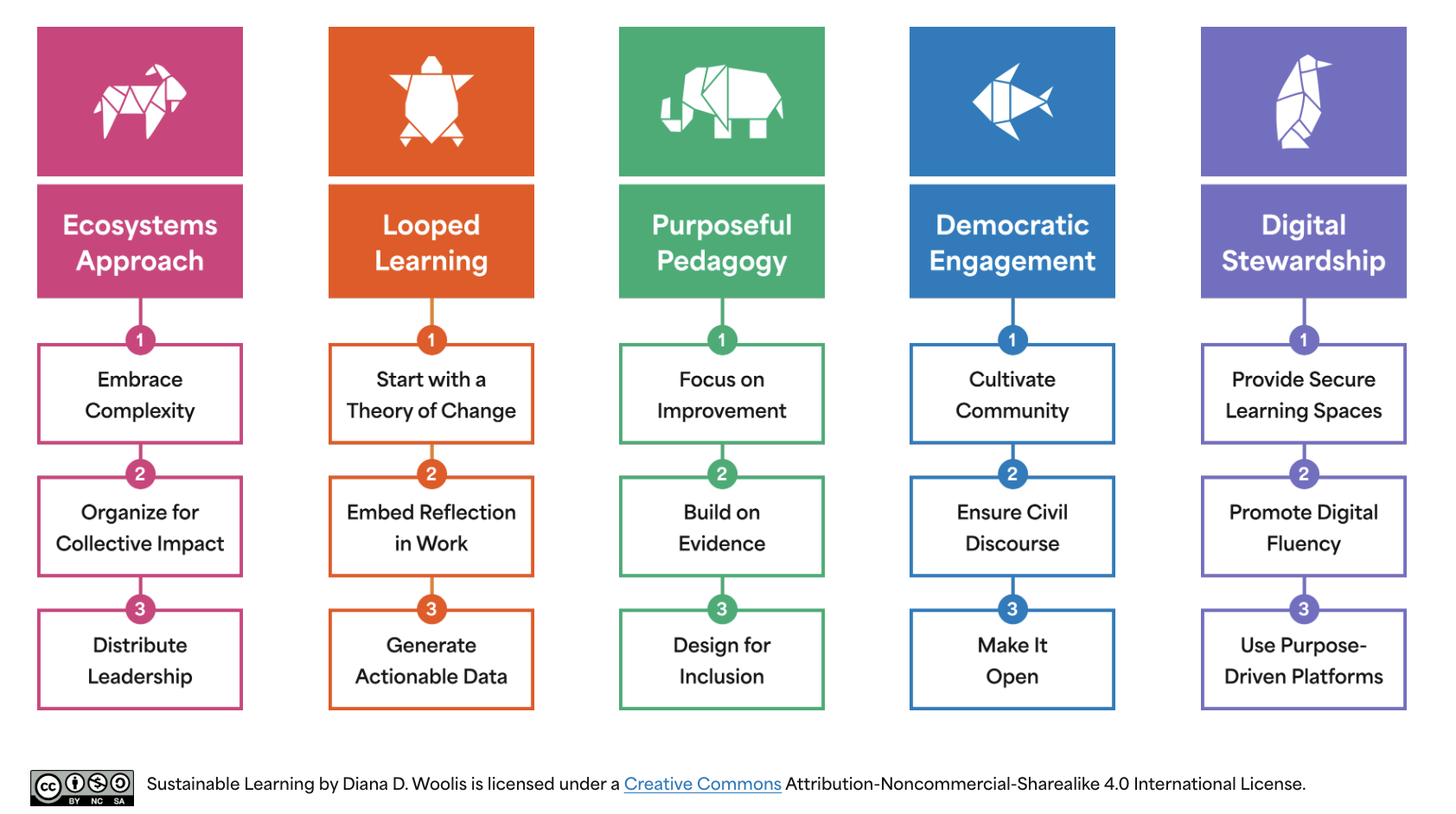
UNICEF answers that question clearly. The Sustainable Learning Framework clarifies why the answer matters: learning outcomes cannot be separated from learning conditions. Without capacity, continuity, and equity by design, even powerful tools undermine the learning they promise to accelerate.
With stewardship, systems gain the capacity to adapt—without displacing learners or exhausting teachers.
The framework is there. The question is whether education systems will embrace stewardship—or continue consuming.
Resources
Beyond Digital as Usual: Digital Education Strategy 2025–2030 — UNICEF
The full strategy. Openly accessible, systems-oriented, and built on operational experience across 100+ countries.
EdTech for Good Framework — UNICEF
Five criteria for evaluating education technology investments: evidence of impact, inclusivity and accessibility, scalability in low-resource contexts, data privacy and online safety, and sustainability strategy.
Six Pillars for Digital Transformation of Education — UNESCO / UNICEF / GPE / ITU
A shared framework for systems-level digital transformation grounded in evidence from diverse contexts.
Sustainable Learning Framework — Learning Agenda
The analytical framework used throughout this piece to evaluate whether education resources support sustainable, equity-centered learning infrastructure

See more #Digital Stewardship resources there.
