
Sustainable Learning Begins with the Design of Interaction
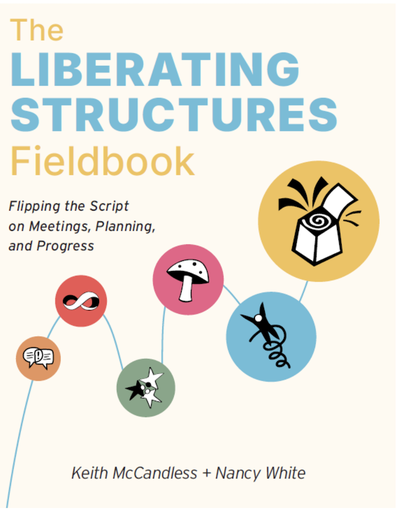
Reflections on The Liberating Structures Fieldbook
Nancy White, Keith McCandless, Henri Lipmanowicz, and the contributors to the newly published Liberating Structures Fieldbookhave produced something education has needed for a long time: a practical answer to the question of how groups actually change the way they work together. Long before “community of practice” entered common use, White was already arguing that technology was never the interesting part of collaboration. The interesting part was always human — how people learn together, how knowledge moves through a community, how relationships shape what becomes possible. That argument runs through the Fieldbook, and it runs through this reflection as well.
Reading the book alongside my recent work on AI governance and educational infrastructure clarified something I had sensed for years without being able to name it. The Sustainable Learning Framework and Liberating Structures are two sides of the same coin. The Sustainable Learning Framework names what a learning ecosystem needs in order to stay adaptive and reciprocal under continual disruption, and offers methods for building that capacity over time. Liberating Structures offers the tools — the actual design of interactions through which that adaptiveness gets practiced, conversation by conversation. One is the discipline; the other is the toolkit that puts it into motion. Neither is complete without the other.
Frameworks Describe Outcomes; They Rarely Show People Where to Start
Education does not lack frameworks. There are frameworks for leadership, digital learning, competency, assessment, AI adoption, organizational change, and institutional transformation, and most of them are reasonably good at describing what a healthy learning system looks like once it exists. What they consistently fail to answer is the more immediate problem: what changes on Monday morning. A framework can tell a ministry that it should hear voices outside its usual decision-making circle without ever specifying how that hearing is supposed to happen in a room, on a given day, with a given agenda. The Fieldbook closes that gap by treating every interaction as something that is already structured, whether anyone designed it deliberately or not. The choice is never between structure and no structure. It is between structure that happened by default and structure that was built on purpose.
That is the premise behind the Fieldbook’s five design elements — invitation, space and materials, participation, group configuration, and sequence. Every meeting, classroom, or planning session is already shaped by decisions in each of these categories, and those decisions are not neutral. They determine who speaks, whose contribution counts as knowledge, and ultimately what a group is capable of learning together.
Interaction Is Infrastructure Too
Much of my recent work has treated artificial intelligence, knowledge systems, governance, and public investment as forms of educational infrastructure — the durable substrate that determines what an institution can do, independent of any single decision its leaders make. Reading the Fieldbook surfaced a form of infrastructure that gets far less attention than any of those: the infrastructure of interaction itself. How people are invited into a conversation, how participation gets distributed across a room, how groups are configured, how reflection is built into a process rather than appended to its end — these are not facilitation techniques in the narrow sense. They are the microstructures that determine whether an organization becomes capable of learning at all.
Macrostructures — policy, hierarchy, strategic plans, funding mechanisms — matter, but they rarely touch what actually happens inside a meeting or a classroom. Microstructures do. And because they recur, they accumulate. A pattern of interaction repeated across enough meetings becomes a culture; a culture sustained long enough becomes an institutional habit; and institutional habits are what eventually determine whether an organization is adaptive or brittle when disruption arrives. This is the connective tissue between the two frameworks: the Sustainable Learning Framework names adaptiveness as the goal, and Liberating Structures supplies the repeatable unit of practice through which adaptiveness is actually built, meeting by meeting.
The Sustainable Learning Framework’s Ecosystems Approach makes a parallel diagnosis at the level of the system as a whole. Education now operates in conditions interconnected and complex enough that the old, linear habits of problem-solving no longer hold; navigating effectively means weighing the far-reaching effects of any single action rather than treating decisions as isolated events with contained consequences. Liberating Structures arrives at the same conclusion from the opposite direction. Its underlying complexity science rejects command-and-control thinking at the scale of a group, arguing that insight and direction emerge from local interaction rather than from a single expert dictating outcomes. The Ecosystems Approach is the claim that complexity must be embraced rather than managed away; Liberating Structures is the practiced mechanism for actually doing that embracing, at the one scale most institutions never redesign — the meeting itself.
Every Meeting Teaches Something
No one needs to present information for a meeting to be educational. A meeting teaches its participants who is expected to contribute, whose knowledge is trusted, how disagreement gets handled, and whether uncertainty is something that can be spoken aloud or something that has to be hidden. None of this is usually written into organizational strategy, and that is precisely why it is so durable: it operates below the level where strategy documents intervene, and it teaches the same lesson every time the pattern repeats.
This is where Democratic Engagement, one of the Sustainable Learning Framework’s principles, stops being aspirational and becomes something a group can actually practice. Democratic engagement does not mean inviting more people into a room; it means building the conditions under which a wider range of perspectives can genuinely shape a decision, rather than simply being heard and then set aside. Structures such as 1-2-4-All, Conversation Café, and Wise Crowds do exactly this by redistributing participation deliberately, so that voices ordinarily filtered out of collective sense-making become part of it by design rather than by exception.
The same logic extends to Looped Learning. The Sustainable Learning Framework holds that resilient organizations do more than accumulate information; they continuously convert experience into new understanding and new action, with reflection built into the work rather than scheduled at its conclusion. What? So What? Now What?, TRIZ, and Appreciative Interviews are repeatable routines for exactly that conversion. They give a group a structured way to examine what happened, name the assumptions underneath it, and decide what to do differently — turning a principle that most organizations endorse in theory into a habit most of them otherwise fail to sustain in practice. The same pattern holds for Digital Stewardship: however much it depends on policy and infrastructure, it ultimately rests on whether the people inside an institution have practiced making judgments together rather than consuming technology decisions handed down to them.
A Framework Becomes Visible
The question I am asked most often about the Sustainable Learning Framework is how to implement it. I have started to think that question assumes the wrong unit of change. Frameworks are not implemented in the way software is installed. They become visible through the recurring practices that shape how people inquire, reflect, solve problems, and make meaning together — and those practices have to be designed, repeated, and sustained long enough to become habits before anyone would recognize the framework operating in the room. The Fieldbook’s contribution is that it does not ask an organization to become different overnight. It asks the organization to redesign its interactions, with the expectation that a different organization follows from that, gradually, over time.
Education is currently absorbing disruption from several directions at once — artificial intelligence, political polarization, displacement, shrinking public investment, and declining institutional trust among them — and the instinct under that kind of pressure is usually to look for a new framework large enough to address all of it. New frameworks will keep arriving, and some will be useful. But the Fieldbook is a reminder that good frameworks begin in conversation. They are not handed down complete; they are built, tested, and revised through the design of a conversation, then a reflection, then a meeting. What Nancy White’s work has insisted on for two decades, in this book as in her earlier writing, is that participation was never the end goal. It was always the mechanism by which people learn to think, decide, and act together, and by which a framework earns the right to be called sustainable in the first place. Success is the result of an ongoing conversation between frameworks, practice, and data, each informing the other through reflective cycles. The thousands of ordinary interactions inside an institution are where that capacity is actually built or lost, long before any policy document records the result.
Resources
The book this reflection is about
Keith McCandless and Nancy White, The Liberating Structures Fieldbook: Flipping the Script on Meetings, Planning, and Progress. The primary reference for this piece. liberatingstructures.com/2026-fieldbook
Start here: the Liberating Structures repertoire and how to use it
The Liberating Structures website is the definitive open resource — all 33 structures described in full, with step-by-step instructions, design guidance, and getting-started advice for practitioners new to the repertoire.
liberatingstructures.com/getting-started
liberatingstructures.com/design-elements — the five design elements (invitation, space and materials, participation, group configuration, sequence) discussed in this piece, with examples.
Connect with the practitioner community
https://www.liberatingstructures.com/commons The LS Commons is the emerging hub for the global LS community — a space for gathering field-tested innovations, connecting with practitioners, and keeping adaptations open and available under Creative Commons. Currently in development and worth bookmarking.
Nancy White's earlier work on community and online facilitation
White's thinking on the human dimensions of online collaboration — predating much of what became standard language in the field — is documented at her blog and practice site, Full Circle Associates.
White, N., Wenger, E., and Smith, J.D. Digital Habitats: Stewarding Technology for Communities. CPsquare, 2009. White's foundational text on technology stewardship and communities of practice — directly relevant to the Digital Stewardship pillar of the Sustainable Learning Framework.
